The Communication Problem: Why Multi-Agent Messaging is Harder Than You Think
Series: Multi-Agent Isolation (Article 3 of 5)
Browser Use proxies LLM calls through a stateless control plane. Now imagine 7 agents, 3 group channels, and messages that must survive crashes. Welcome to the distributed systems problem nobody warned you about.
Thesis: Multi-agent communication is a distributed systems problem requiring durable state and delivery guarantees. Getting it wrong doesn’t mean a dropped message — it means coordinated work collapses.
Introduction
Browser Use’s stateless FastAPI control plane is elegant for what it does: proxy LLM calls to a cloud provider, manage file sync via S3 presigned URLs, enforce cost caps through middleware. State lives in the database. The control plane itself can restart, scale horizontally, or fail over without losing anything. It is a clean, well-understood architecture pattern.
But what happens when you move from one agent to seven?
Multiclaw has an Orchestrator, a PM, and four execution agents (Engineering, QA/Validation, Research/Design, Growth/GTM) — plus a Communication Adapter that routes everything. These agents don’t just make LLM calls through a proxy. They send messages to each other. They broadcast to group channels. They coordinate work through structured contracts. And the messaging layer isn’t just plumbing — it is the coordination layer itself.
A stateless proxy cannot do this. The moment you have agents talking to agents, you need ordering guarantees, delivery acknowledgments, crash recovery, and backpressure. You need, in short, a distributed messaging system. And building distributed messaging systems is one of the hardest problems in software engineering.
There is a deeper reason these guarantees matter beyond standard distributed systems hygiene. We do not trust any individual agent to handle communication failures correctly on its own. An agent that misses a policy update and operates under stale rules is a containment risk. An agent that processes a duplicate task assignment and performs the same work twice wastes resources and may produce conflicting results. An agent that never receives a cancellation message will continue work that should have stopped. The Communication Adapter’s delivery guarantees are not just engineering best practice – they are containment infrastructure, ensuring that agent mistakes in one part of the system do not cascade through unreliable messaging into failures across the entire ensemble.
The Communication Adapter handles real-time operational messaging – task assignments, escalations, status updates. But agents also need persistent knowledge: accumulated context, architectural decisions, and research findings that outlive individual message threads. Obsidian knowledge vaults serve this complementary role, providing per-agent Markdown-based knowledge stores that persist indefinitely alongside the adapter’s message routing. This article focuses on the operational messaging side – the adapter – while the knowledge persistence layer is covered in Article 2’s defense-in-depth discussion.
This article walks through each of these challenges and the concrete specifications I developed for Multiclaw to address them.
Why Stateless Fails for Multi-Agent
Browser Use’s control plane is stateless because it can afford to be. The architecture is fundamentally single-agent: one user session, one browser agent, one conversation thread. State lives in a PostgreSQL database. The FastAPI server is a pure function — request in, response out, no memory between calls. If it crashes, restart it. If you need more capacity, add instances behind a load balancer. Statelessness is the right call.
Multi-agent changes every assumption that makes statelessness viable.
Agents send messages to other agents. When the PM assigns a task to the Engineering agent, that assignment must arrive. Not “probably arrives.” Not “arrives if the proxy happens to be up.” Arrives, period, with confirmation. The PM needs to know the assignment was received so it can track progress. If the message vanishes into the void, the PM sits idle waiting for a status update that will never come.
Group channels broadcast to subsets. Multiclaw defines three static channels: all-agents (all 6 agents), product (PM plus 4 execution agents), and platform (Orchestrator plus Communication Adapter). When the Orchestrator pushes a policy update to all-agents, every agent must receive it. If two agents get the update and four don’t, you have agents operating under different policy versions simultaneously — a recipe for conflict, confusion, and escalation storms.
Message ordering matters for coordinated work. Agent A sends “start task X.” Agent A then sends “cancel task X” because requirements changed. If those messages arrive out of order, agent B starts work that was already cancelled. In a single-agent proxy model, ordering is trivial — it is just sequential HTTP requests. In multi-agent with group channels and concurrent senders, ordering is a genuine distributed systems challenge.
The messaging layer IS the coordination layer. In Browser Use, the control plane proxies calls to an LLM provider. If you swapped it for a different proxy, the agent wouldn’t notice. In Multiclaw, the Communication Adapter doesn’t just pass bytes. It assigns sequence numbers. It persists messages to durable storage. It manages delivery acknowledgments and retries. It implements backpressure. It is, functionally, the central nervous system of the entire multi-agent deployment. A stateless proxy cannot fill this role.
Delivery Guarantees
The first question any distributed messaging system must answer: what happens when a message doesn’t arrive?
Multiclaw defines at-least-once delivery as the baseline guarantee. This is a deliberate choice. Exactly-once delivery is a distributed systems unicorn — achievable in theory, nightmarish in practice, and unnecessary if your consumers are designed correctly. At-most-once delivery (fire and forget) is unacceptable when messages represent task assignments, policy updates, and escalation requests. At-least-once is the pragmatic middle ground: every message arrives at least once, and consumers handle duplicates.
Here is how the guarantee is implemented.
Persist before acknowledge. When an agent sends a message, the Communication Adapter persists it to the durable store (SQLite in WAL mode) before returning a routing acknowledgment to the sender. If the adapter crashes between receiving the message and persisting it, the sender never gets an acknowledgment and retries. If the adapter crashes after persisting but before acknowledging, the sender retries and the adapter deduplicates via the idempotency key. No message is lost.
Retry with backoff. If the adapter cannot deliver a message to the target agent (agent is down, queue is full, network partition), it retries 3 times with exponential backoff. Three retries is enough to survive transient failures without hammering a struggling agent.
Dead-letter with alerting. After 3 failed delivery attempts, the message moves to a dead-letter store. This is not a silent failure — the dead-letter event triggers alerting to the Orchestrator, which can escalate to the Human Governor if the target agent appears to be permanently down. Dead-lettered messages are preserved for manual replay once the underlying issue is resolved.
Idempotent handlers. Because at-least-once means duplicates are possible, every agent must implement idempotent message handlers. Processing the same message twice must produce the same result as processing it once. This is a design constraint pushed to the agent level because the alternative — exactly-once delivery in the adapter — is dramatically more complex and fragile.
The MessageEnvelope contract encodes all of this:
idempotency_key: Client-generated UUID. The adapter and receiving agents use this to deduplicate.channel_sequence_id: Adapter-assigned monotonic integer per channel. This is the ordering primitive.timestamp_iso8601: Adapter-assigned receipt timestamp. Wall-clock time for debugging and retention.reply_to_sequence_id: Optional, for threading. Enables agents to correlate responses with requests.
Agents track the last-seen channel_sequence_id for each channel they subscribe to. If an agent sees sequence 47 followed by sequence 49, it knows sequence 48 is missing and triggers a replay request to the adapter. Gaps are detected, not silently ignored.
Compare this with Browser Use’s model: the agent makes an HTTP request to the control plane, the control plane proxies it to the LLM provider, the response comes back. If the request fails, the client retries. There is no message persistence, no sequence numbering, no dead-letter handling — and none is needed, because there is only one agent making synchronous requests. The complexity gulf between “proxy HTTP calls” and “guarantee delivery across 7 asynchronous agents” is enormous.
Backpressure and Bounded Queues
What happens when an agent falls behind? In a single-agent model, this question doesn’t arise — the agent sends a request, waits for the response, sends the next request. It is inherently self-throttling.
In a multi-agent system, agents produce messages concurrently and independently. And because we do not trust any agent to self-regulate its own output volume, the infrastructure must enforce the limits. The Engineering agent might be humming along while the QA/Validation agent is stuck in a long test run and not consuming messages. Meanwhile, the PM keeps sending task updates, the Orchestrator pushes policy changes, and the Research/Design agent broadcasts findings to the product channel. The QA/Validation agent’s inbox is growing. An agent in a reasoning loop could also flood a channel with redundant status updates, overwhelming every other agent’s queue.
Without backpressure, this ends in one of two ways: unbounded memory growth (the adapter stores messages forever until it runs out of RAM) or silent message loss (the adapter drops messages when it gets overwhelmed). Both are unacceptable.
Multiclaw’s backpressure design:
Per-agent bounded queue. The adapter maintains a bounded queue per agent with a default capacity of 500 messages. This is large enough to absorb bursts (a flurry of product channel broadcasts during a planning session) without allowing runaway growth.
Overflow policy with priority awareness. When a queue hits capacity, the adapter evicts the oldest non-critical messages to the dead-letter store. Critical messages — escalations, policy updates, governance directives — are never evicted. This means an agent that falls behind will lose old task status updates before it loses a policy change that affects its security posture. The priority distinction is essential; a naive FIFO eviction could drop an escalation that the Human Governor needs to see.
Pull model with long-poll. Agents consume messages via a pull model with long-poll rather than push. This is a deliberate choice. In a push model, the adapter must track connection state for every agent, handle reconnections, and manage per-agent TCP buffers. In a pull model, the agent decides when it is ready for more messages. Long-poll keeps latency low — the agent blocks on a poll request and the adapter responds immediately when a message is available — without the complexity of persistent push connections.
Browser Use has no backpressure concern whatsoever. One agent, synchronous request/response, inherently bounded by the agent’s own processing speed. When you go from one agent to seven, backpressure goes from “not applicable” to “if you get this wrong, the system degrades unpredictably under load.”
Group Channels
Individual point-to-point messaging is already a distributed systems problem. Group channels make it harder.
Multiclaw defines three static group channels:
| Channel | Members | Purpose |
|---|---|---|
all-agents | All 6 agents | System-wide broadcasts (policy updates, emergency alerts) |
product | PM + 4 execution agents | Product coordination (task assignments, status updates, design reviews) |
platform | Orchestrator + Communication Adapter | Infrastructure coordination (health checks, capacity alerts) |
All three use broadcast delivery mode: every member of the channel receives every message. There is no pub/sub topic filtering, no selective consumption. If a message goes to product, all five members get it.
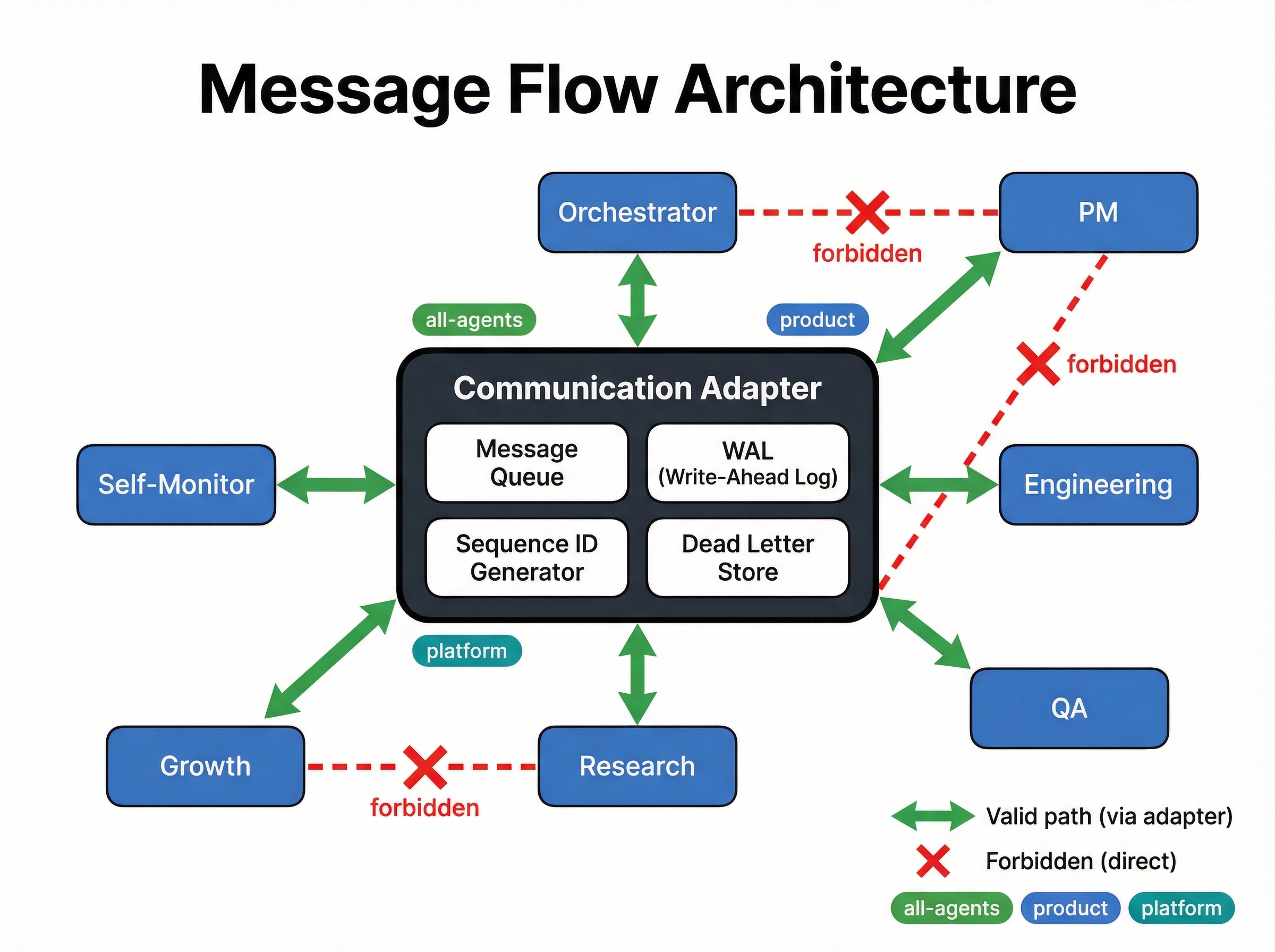
This means the adapter must implement fan-out routing. When the PM sends a message to product, the adapter must:
- Persist the message to the durable store.
- Assign a
channel_sequence_idfor theproductchannel. - Enqueue the message in the individual queues of all 5
productchannel members. - Track delivery status per recipient independently.
- Retry failed deliveries per recipient independently.
- Dead-letter per recipient independently.
Step 3 through 6 are the hard part. A message might be delivered successfully to four agents but fail for the fifth. The adapter must track this per-recipient state and retry only for the failed recipient, not re-deliver to the four that already received it.
This is fan-out routing that the underlying transport — mcp_agent_mail in phase 1 — does not provide natively. mcp_agent_mail is a transport medium that handles point-to-point message passing. Group channel semantics, fan-out, per-recipient tracking — all of this is the adapter’s responsibility. The adapter is not a thin wrapper around a transport. It is a routing engine.
Membership is static. Channel membership is defined at provisioning time and cannot be changed without Orchestrator action plus human approval. This is a deliberate simplification. Dynamic channel membership (agents joining and leaving channels at runtime) introduces a cascade of complexity: membership change ordering, message visibility during membership transitions, split-brain scenarios during concurrent membership changes. Static membership eliminates all of this. For Multiclaw’s current topology of 6 agents, the simplification is well worth it.
Crash Recovery and WAL
The Communication Adapter is a single point of failure. I acknowledge this explicitly rather than pretending it away. In a single-host deployment, there is no clustering, no failover replica, no multi-region redundancy. If the adapter crashes, inter-agent communication stops.
The question is not “can the adapter crash?” — it can. The question is “how fast does it recover, and what happens in the meantime?”
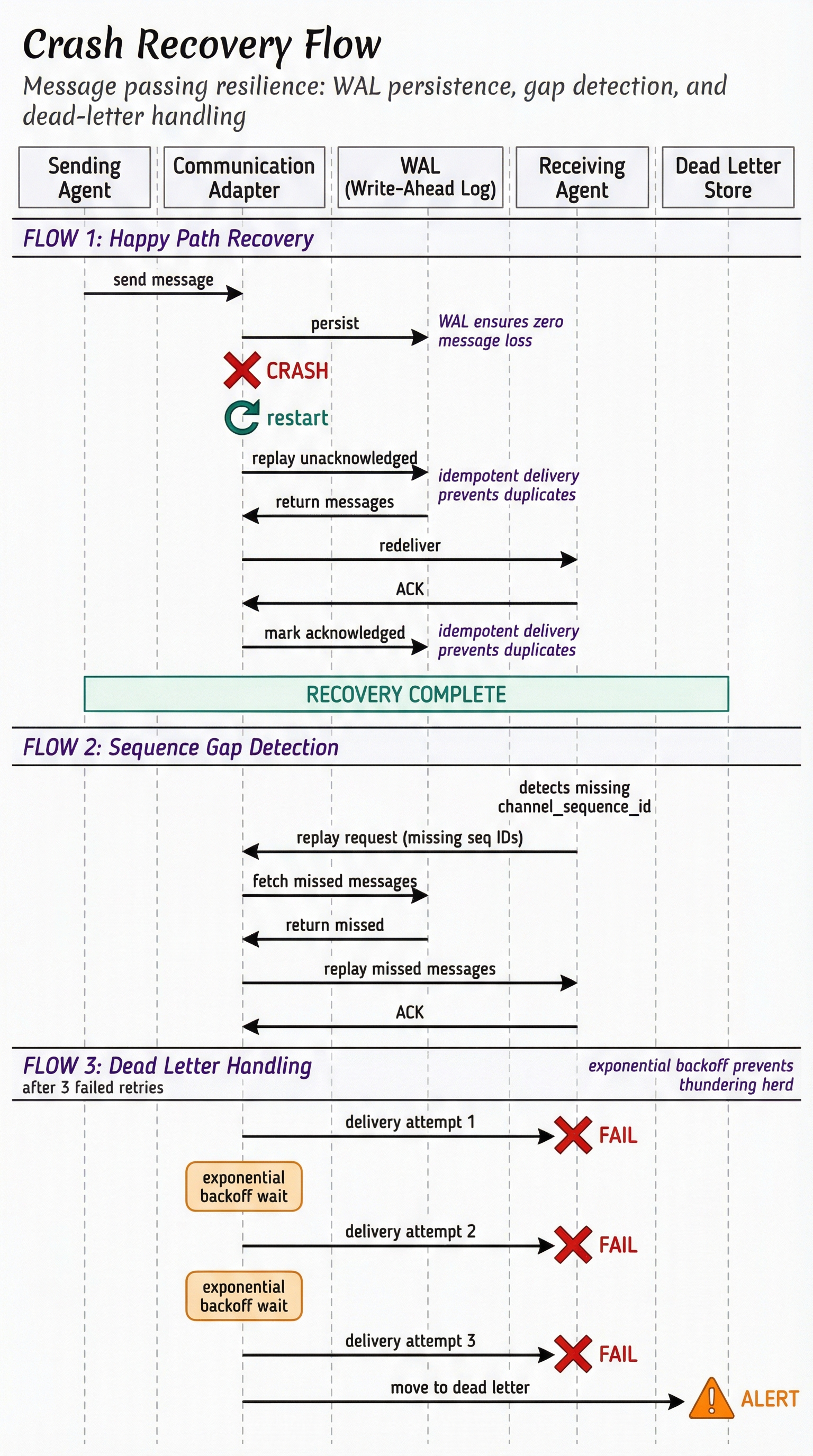
SQLite WAL mode. The adapter’s durable store uses SQLite in Write-Ahead Logging mode. WAL mode is critical for crash recovery: writes go to the WAL file first, and the main database file is updated during checkpoints. If the adapter crashes mid-transaction, the WAL file contains the uncommitted entries. On restart, SQLite replays the WAL and the database is consistent. No manual recovery, no data loss for persisted messages.
RTO target under 10 seconds. The adapter is managed by systemd with auto-restart (RestartSec=2, max 5 retries per 300 seconds). Combined with SQLite WAL replay (which is fast — this means replaying a small number of uncommitted entries, not rebuilding from scratch), the recovery time objective is under 10 seconds. For a non-realtime multi-agent coordination system, 10 seconds of downtime is acceptable.
Gateway sidecar outbox. During adapter downtime, agents don’t just drop messages on the floor. Each agent’s gateway sidecar maintains a bounded local outbox queue of up to 1,000 messages. When the agent sends a message and the adapter is unreachable, the message goes into the local outbox. When the adapter comes back (detected via /health endpoint polling), the outbox drains automatically. 1,000 messages is enough to buffer several minutes of typical multi-agent communication without risking unbounded memory growth.
Circuit breaker per agent. The gateway sidecar implements a circuit breaker with exponential backoff for adapter communication. If the adapter is down, the sidecar doesn’t hammer it with connection attempts. It backs off exponentially, reducing load on the recovering adapter and preventing thundering-herd reconnection storms when the adapter comes back up.
Emergency channel. When the adapter is completely down and the normal messaging path is unavailable, agents can still emit structured journald entries with priority=CRIT. The Orchestrator monitors journald for these emergency signals. This is an out-of-band communication path that bypasses the adapter entirely — a last resort, not a primary channel, but essential for scenarios where the adapter itself is the problem.
Readiness gating. The adapter MUST expose a readiness signal (systemd notify or /health endpoint). Agent pods gate on this signal before starting their OpenClaw runtime containers. This prevents a race condition where agents start up, try to send messages, fail because the adapter isn’t ready yet, and waste their retry budget before the adapter even finishes initialization.
Durable Store Specification
The adapter’s durable store is not an implementation detail — it is a specified component with defined properties.
Engine: SQLite in WAL mode. SQLite is chosen deliberately. It is a single-file database that runs in-process, requires no separate database server, and has decades of production-proven reliability. WAL mode provides concurrent read access during writes and crash-safe transactions. For a single-host deployment handling communication for 7 agents, SQLite’s performance ceiling is orders of magnitude above Multiclaw’s needs.
Retention policy. Configurable per channel type:
- Messages: 30 days default retention, then pruned.
- Contracts (task assignments, policy decisions): indefinite retention. These are the audit trail.
Note: this retention policy governs the adapter’s operational message store. Per-agent Obsidian knowledge vaults have indefinite retention by default – they serve a different purpose (persistent knowledge accumulation rather than transient message delivery).
Integrity: page-level checksums. SQLite’s checksum VFS extension enables page-level integrity verification. The adapter can detect corruption at read time rather than silently returning garbage data.
Capacity envelope: 100K messages minimum. The store must support at least 100,000 messages without performance degradation. With an average message size of 2KB (JSON envelope plus payload), that is roughly 200MB — well within SQLite’s comfortable operating range. A busy 7-agent deployment producing 1,000 messages per day would take 100 days to hit this floor, and retention-based pruning prevents unbounded growth.
Corruption recovery. On startup, the adapter runs an integrity check against the database. If corruption is detected, it attempts to rebuild from the WAL. If the WAL cannot repair the corruption (catastrophic disk failure, for example), the adapter alerts the Human Governor for manual recovery. This is an honest acknowledgment that some failure modes require human intervention — better to alert and wait than to silently operate on corrupt data.
Conclusion
Multi-agent messaging is not “just add a message queue.” It is a distributed systems problem with all the classic challenges that distributed systems engineers have been wrestling with for decades.
Ordering. Messages must arrive in a sequence that makes semantic sense, even when multiple agents send concurrently to shared channels. Monotonic sequence IDs per channel and gap detection give agents the tools to reconstruct correct order.
Delivery. Messages must actually arrive. At-least-once delivery with persist-before-acknowledge, bounded retries, dead-letter stores, and idempotent consumers form a guarantee chain that doesn’t depend on everything going right — it handles things going wrong.
Durability. Messages must survive crashes. SQLite WAL mode, local sidecar outboxes, and startup integrity checks ensure that a process restart doesn’t mean data loss.
Backpressure. Fast producers must not overwhelm slow consumers. Bounded per-agent queues with priority-aware eviction and pull-based consumption keep the system stable under asymmetric load.
Failure recovery. The adapter will crash. The question is recovery time and data preservation. Sub-10-second RTO with automatic WAL replay, circuit breakers to prevent thundering herds, and out-of-band emergency channels via journald make failure a manageable event rather than a catastrophe.
Browser Use’s stateless proxy is the right architecture for single-agent LLM orchestration. It is also a useful baseline for understanding what multi-agent communication adds: every property listed above is unnecessary for a single agent, and every one becomes critical the moment you have multiple agents coordinating work. The jump from one to many isn’t a linear increase in complexity. It is a category change.
This is especially true when the agents themselves are not trusted to handle failures gracefully. An autonomous agent that misses a message will not file a bug report – it will silently operate on incomplete information, making decisions based on stale state. The Communication Adapter exists because we design for that reality.
If you are building a multi-agent system and you haven’t thought about message ordering, delivery guarantees, backpressure, and crash recovery, you don’t have a communication layer. You have a hope.
Series Navigation
- Article 1: The Two Patterns of Agent Isolation (and Why You Need a Third)
- Article 2: Seven Users, Seven Vaults: Defense-in-Depth for Multi-Agent Systems
- Article 3: The Communication Problem: Why Multi-Agent Messaging is Harder Than You Think (you are here)
- Article 4: Governance by Architecture: How to Stop Your Orchestrator From Going Rogue
- Article 5: Two Deployment Paths: When Your Multi-Agent Host Should Leave Your Laptop